
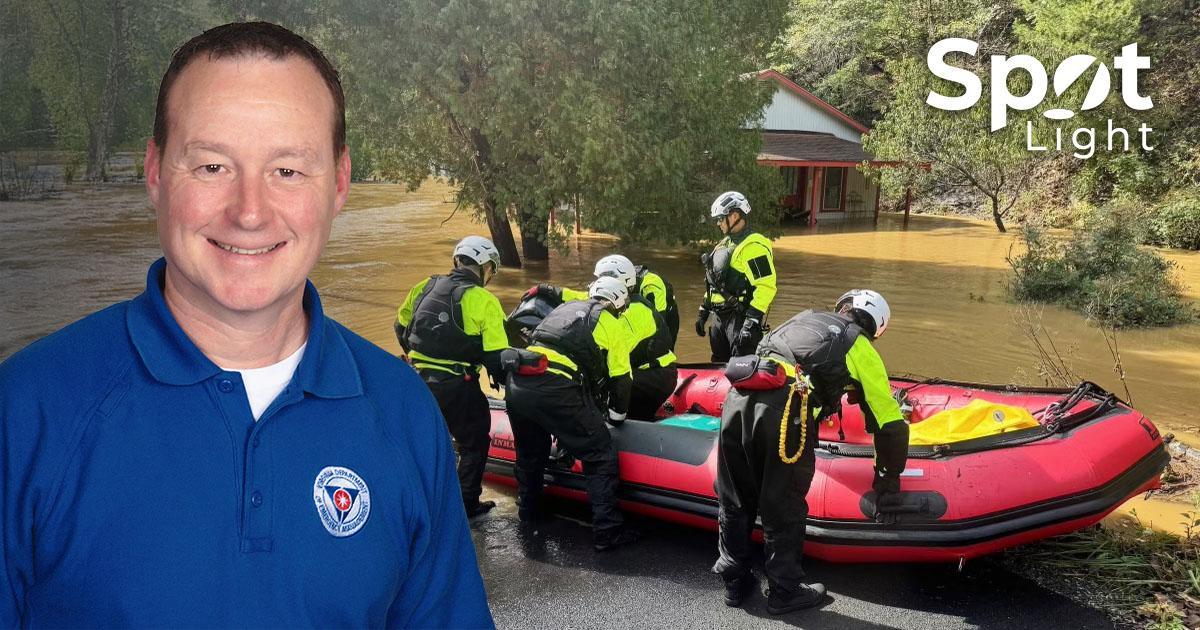
The calls started before dawn. Hurricane Helene had torn through Southwest Virginia with a fury few had anticipated, and by sunrise on September 27, 2024, Bryan Saunders knew the scope of what his teams were facing.
It was the largest disaster he’d seen on the job. Flooding had isolated entire communities. Pockets of rainfall — nearly 11 inches in some areas — dumped regionwide had turned roads into rivers. People needed help, and they needed it fast.
As director of the special operations division at the Virginia Department of Emergency Management, Saunders orchestrated the response in an operations center miles from the floodwaters. His teams would complete more than 136 rescues and save dozens of pets.
While the profession has transformed over his nearly four decades in public safety, one thing has remained constant: “I like being part of a large response team that someone can call in the middle of the night and get a solution.”
When disaster strikes, the relationships he’s built throughout his career ensure a swift, coordinated response.
Learning Hard-Fought Lessons
Saunders’ division at VDEM manages a wide array of emergency responses year-round. He directs and coordinates with team leaders to perform search and rescue missions in wilderness and urban environments. His teams conduct water rescue and air operations. They respond to hazardous material spills and brace for larger potential disasters, should a radiological emergency occur at Virginia’s two nuclear power plants.
The response framework exists partly because at the state level Virginia watches and learns.
“We’ve positioned ourselves in a way that we can support an incident the size of Helene,” Saunders says.
When Hurricane Ian hammered North Carolina in 2022, Saunders and his teams were there. They studied how their neighbors managed the crisis. When Helene struck Buncombe County, North Carolina, two years later, they helped apply those lessons in real time. North Carolina’s emergency management director later presented Saunders with an award for his department’s support during both disasters.
“We continuously watch what happens in these bigger events, and our plans evolve based on what we’re seeing,” Saunders says.
Bryan Saunders
VDEM Special Operations Division Director
- Led response to Hurricane Helene in Southwest Virginia.
- Oversees search and rescue, water rescue, hazardous materials, air operations and radiological emergency preparedness.
- Employed in public safety since 1988.
- Co-founded Virginia Military Institute’s EMT Response Program in 1991.
Embracing the Power of Preparation in His Own Life
With less than a decade before retirement, Saunders approaches post-career planning with the same attention he brings to his role at VDEM. Having a savings plan in place has made all the difference, he says. This is true especially for public safety workers who can often expect to retire at a younger age than many professions.
“The earlier they start, the better off they’re going to be down the road,” Saunders says. “My advice would be figure out a way how, even if it’s a small percentage, to start [saving].”
He often points colleagues toward VRS resources for guidance. “VRS has folks that can do that for you if you don’t have a financial advisor.”
(In fact, VRS offers several ways to help you feel more prepared about your benefits, including virtual and in-person counseling appointments and a range of educational sessions. See the Education page for more.)
When retirement comes, Saunders plans to travel more and step away from the often-breakneck pace of emergency management. But that’s down the road. “I’ve got two governors left.”
Cultivating Quiet Competence
In the meantime, Saunders seeks new ways to bolster the backbone of the state’s emergency preparedness apparatus: volunteer emergency responders. After all, he made his start in the field as a volunteer in the town of Marion during the late 1980s.
Virginia’s 20 wilderness search and rescue teams comprise nearly 500 volunteers on call around the clock. Even the urban search and rescue teams include volunteer firefighters and rescue personnel working alongside career staff.
Despite receiving little or no compensation, these responders don’t seek recognition, Saunders says. He calls them silent professionals.
“These folks want to get out the door, and they want to get in the fight,” he says. “I don’t know one of them that does it so they can get on the news or so they can be in the spotlight.”
It surely helps to have a leader like Saunders modeling the way.